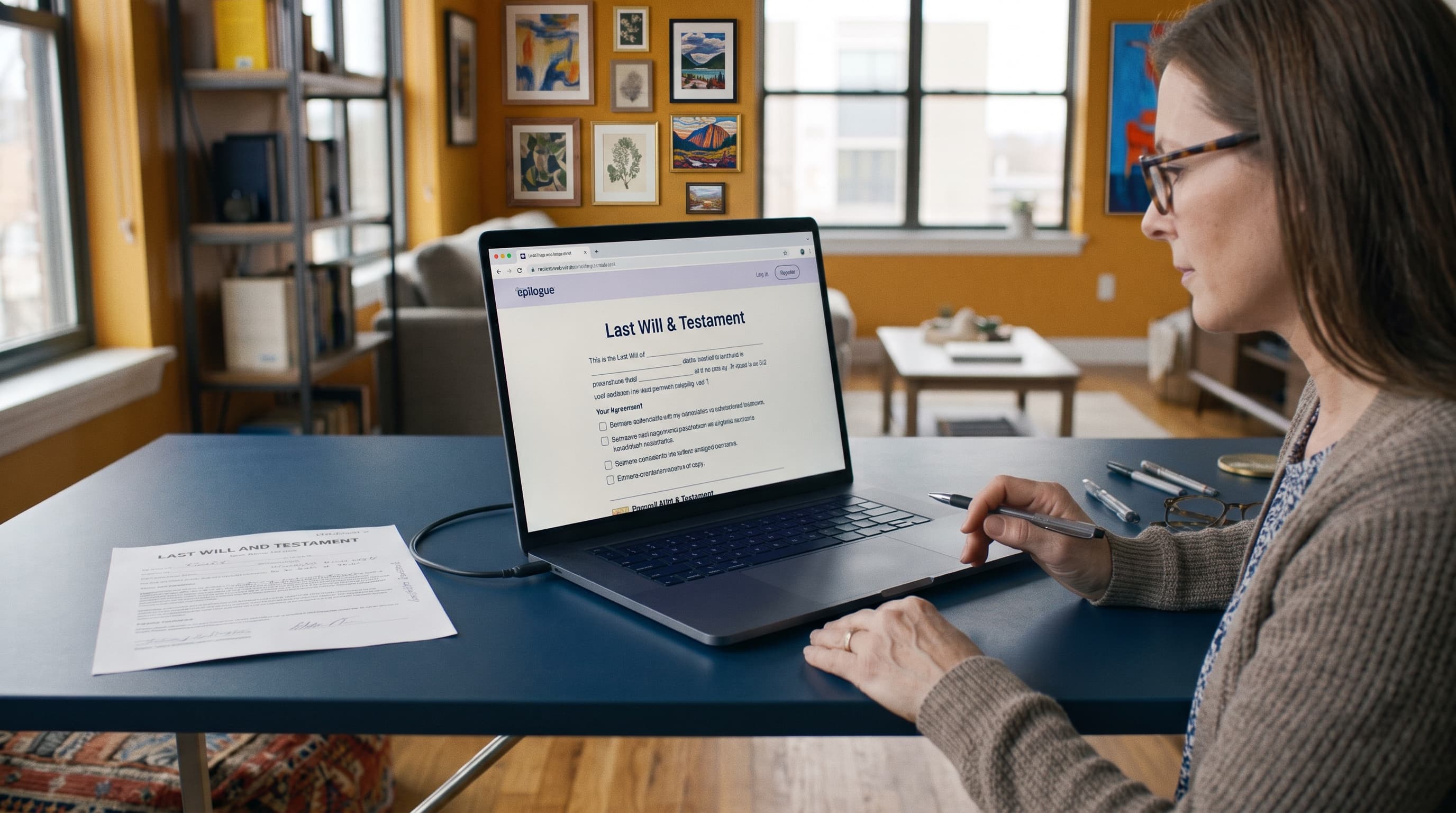
Is an Online Will Legally Valid in Canada? Does It Hold Up in Court?


To be a valid Will in Canada, a number of conditions must be met. However, the way that the Will was created — whether drafted by a lawyer or created through an online platform — is not one of them. So, a Will prepared through a platform like Epilogue is valid, as long as it is printed, signed, and witnessed according to the rules of the province where the Will-maker lives. Epilogue is available in all ten provinces, was founded by two former estate lawyers, and every plan includes detailed signing instructions so the final steps can be completed correctly.
The same is true when it comes to the question of whether a Will created online will hold up in court. A Will that meets the formal requirements of the Will-maker's province generally holds up in court the same way any other valid Will does. The questions that matter to a court when it comes to a Will are the same for every Will: Did the Will-maker have the mental capacity to make the Will? Does the Will reflect the Will-maker's wishes? Is the Will clear? Was the Will signed and witnessed correctly? When a Will comes before a court, it is a physical document that doesn't necessarily indicate whether it was prepared by a lawyer or created through an online process.
So the right question to be asking is not "Are online wills allowed?", but instead "What makes a Will valid, and how does a person avoid the mistakes that cause trouble later?" That is what the rest of this guide explains.
What makes a Will valid in Canada
Each province sets its own rules, but the requirements for a standard (formal) Will are broadly similar across the country.
Age and capacity. The Will-maker generally has to be old enough and mentally capable of understanding what they are signing.
In writing. A Will generally has to be a written document. An audio or video recording of someone stating their wishes is generally not a valid Will.
Physical document. With one exception (discussed below), a Will needs to be in printed, physical (paper) format. In other words, you can't e-sign a Will.
Signed by the Will-maker. The Will-maker signs the Will at the end of the document.
Two witnesses. The Will-maker's signature is made in front of two witnesses who are present at the same time, and the witnesses then sign as well.
The right witnesses. A beneficiary, potential beneficiary, or the spouse or partner of a beneficiary or potential beneficiary should not act as a witness to someone's Will. If they do, then the beneficiary is at risk of losing their entitlements under the Will.
A lawyer or notary does not need to prepare, witness, certify, or notarize a Will for it to be valid. As long as a Will complies with the laws of the province where the Will-maker lives, the Will is valid.
Some provincial differences
Every province has rules which state that, for a formal Will to be valid, it must be signed and witnessed in the manner referred to above. However, there are also some unique exceptions and rules in certain provinces.
Some provinces, like Ontario and British Columbia, have rules that allow Wills to be witnessed remotely. This means that the Will-maker and the witnesses do not need to physically be in the same place, but can instead conduct the signing and witnessing over video conference. At the meeting, each person signs a physical, paper copy of the Will, and the Will is only valid when all of the copies are together. In Ontario, remote video witnessing is only valid if at least one of the witnesses is a lawyer or paralegal licensed by the Law Society of Ontario.
British Columbia has gone one step further by also allowing Wills to be signed in electronic form (digitally). It is currently the only province that permits electronic Wills. However, even in British Columbia, physical paper Wills are still the preferred approach.
A unique feature of Quebec law is that it recognizes notarial Wills, which are prepared and executed by a notary in the presence of a witness. Unlike Wills made in the presence of witnesses, notarial Wills do not need to be probated after the Will-maker dies. A notarial Will must be prepared by a notary and cannot be created through an online Will platform.
In practice, an Epilogue Will is a formal, typed Will that needs to be printed, signed, and witnessed according to the instructions for the Will-maker's province.
What it means for a Will to "hold up in court"
Most Wills never go near a courtroom. When a Will is reviewed by a court, typically during probate, the court is generally evaluating a few practical questions, including whether the Will-maker had capacity, whether the document was signed and witnessed as the law requires, and whether the wording of the Will is clear.
When evaluating a Will for the purposes of granting probate, the court is not evaluating how the Will was made. A typed Will that was correctly signed and witnessed is generally treated the same whether it came from a law office or from an online service like Epilogue.
Some provinces also give courts room to fix technical errors. In British Columbia, for example, a court can order that a document which does not meet the formal rules be treated as a valid Will if it reflects what the deceased person intended. That is a safety net, though, not a plan, and relying on it typically means time and legal costs for the family.
When someone talks about a Will "holding up in court", they may also be asking about whether the Will would hold up to being challenged. Even when a Will meets the formal signing and witnessing requirements, it may still be challenged on other legal grounds, including lack of testamentary capacity, undue influence, or concerns about whether the document reflects the Will-maker's true intentions.
If someone has a specific concern that their Will could be challenged — for example, because there could be a question about their mental capacity or an allegation that the decisions in their Will were influenced by someone else — they may want to work with a lawyer to create their Will, rather than use an online platform. Lawyers can speak to the Will-maker directly, take notes from their meetings, provide legal advice, and draft custom clauses into a Will, while online platforms cannot do these things.
Where people usually go wrong
The pitfalls that can result in a Will being invalid include:
Never signing it. A Will that is drafted but never signed and witnessed is not a valid Will.
The wrong witnesses. Using a beneficiary, potential beneficiary, or a spouse/partner of a beneficiary or potential beneficiary can put someone's entitlement at risk.
Witnesses not present together. Both witnesses must be present when the Will is signed by the Will-maker and the witnesses themselves.
Unclear wording. Vague descriptions of people or property can leave room for disagreement about what was meant.
An outdated Will. A marriage, separation, new children, or a move between provinces can affect how a Will works, and an old Will may no longer say what the Will-maker would want.
Complex situations without advice. Some situations call for a lawyer, as discussed more below.
How Epilogue reduces mistakes
Epilogue is built around the idea of a safer document: one that holds up when it is needed and keeps up as a family changes.
Built by lawyers. Epilogue was founded by two former estate lawyers, and its questionnaire asks simple questions, without legal jargon, to create a custom Will.
Detailed signing instructions. Every plan includes step-by-step instructions for printing, signing, and witnessing, which is the step that makes a Will legally binding.
Free updates for life. Documents can be updated anytime, for free, so a Will can be changed as life changes. After an update, the new Will needs to be signed and witnessed in order to replace the old one.
Preview before paying. The documents can be previewed before any payment.
Honest about limits. Epilogue's own guidance is that legal advice can be helpful in certain situations, including for someone who wants to exclude a spouse or child from their Will, someone with children from a prior relationship, or someone who has a child with a disability who receives government benefits.
Clear prices. A Will is $139, or $199 with incapacity documents. For couples, Wills are $269, or $329 with incapacity documents. Each plan also includes a code to register the Will with the Canada Will Registry. Full details are on the Epilogue pricing page.
For a side-by-side look at how Canadian online Will services compare on price, updates, and features, see Epilogue's comparison of the best online Will services in Canada. Parents can also read the guide to appointing a guardian for minor children, one of the most important decisions in a Will.
FAQ
Is a Will made online legally valid in Canada?
Generally, yes. A Will made online is valid in the same way as any other Will, as long as it is printed, signed, and witnessed according to the province's rules. Epilogue is available in all ten provinces and includes detailed signing instructions with every plan.
Do online Wills hold up in court in Canada?
A Will that meets its province's signing and witnessing rules generally holds up in court the same way as a Will drafted at a law office. Courts typically look at how the Will was signed and witnessed, the Will-maker's capacity, and the clarity of the wording, not at how it was drafted. If there are concerns about potential future challenges to a Will on account of issues like mental capacity or undue influence, it would be best to work with a lawyer rather than create your Will online.
What should be confirmed to make sure a Will created online is legally valid?
The Will-maker must meet the age and capacity requirements, and the Will must be in writing, printed, and signed at the end in the presence of two witnesses who are present at the same time. The witnesses must also sign the Will in the presence of the Will-maker and each other, and no witness should be a beneficiary or the spouse or partner of a beneficiary (if they are, it could invalidate a gift). Rules vary by province, so following province-specific signing instructions matters.
Does a lawyer need to witness or approve an online Will?
No. There is no legal requirement in Canada for a lawyer to prepare, witness, certify, or notarize a Will. Legal advice can still be helpful in more complex situations, such as excluding a spouse or child.
Which online Will services in Canada are legally binding and trustworthy?
Any service whose Wills are properly signed and witnessed can produce a legally binding Will. Epilogue was founded by two former estate lawyers, covers all ten provinces, includes detailed signing instructions and free lifetime updates, and lets people preview their documents before paying.
Disclaimer: Epilogue is not a law firm and cannot provide any legal advice. This article is for informational purposes only and may not cover all legal considerations. For complex estate planning needs, consult a qualified estate planning professional.