What Happens to My Will if an Online Will Company Shuts Down?
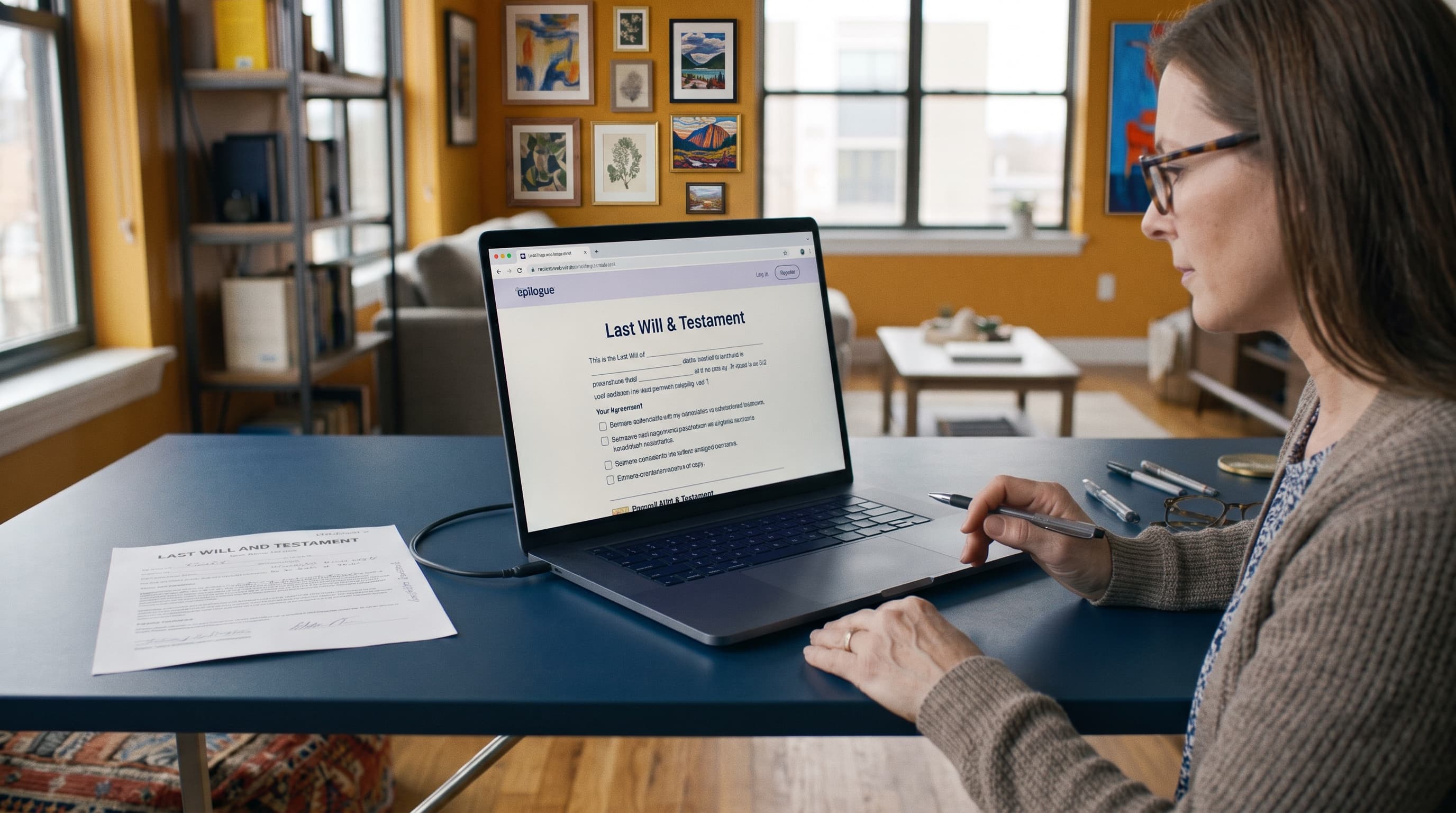

In most Canadian provinces, a Will is generally made by printing the document, signing it, and having it witnessed according to provincial requirements.
The important point is that once the document has been properly executed, its validity does not depend on the continued operation of the platform used to create it. So if the organization that helped you create your Will shuts down—whether an online Will platform or a law firm—a properly executed Will does not become invalid simply because that organization no longer exists.
An online platform is just a tool that is used to create the document. The actual Will itself is the paper copy that the Will-maker signed in front of witnesses. According to Epilogue's Chief Technology Officer: "Once created and properly signed, a Will's validity does not depend on Epilogue."
If an online Will platform closes, that can affect convenience, including the working copy of the Will stored online and the ability to update the document through the platform. This guide explains what happens if an online Will platform closes, how to protect your Will and personal information, and what Epilogue does to safeguard its users' data.
What you hold and what Epilogue holds
It is important to understand who holds what information and who is responsible for what.
What the Will-maker is responsible for:
The signed original Will. In most provinces, a Will generally becomes legally effective only once it is printed, signed, and witnessed by two eligible witnesses.
Where the Will is kept. The original should be stored somewhere safe that the executor knows about and can access if they need to.
Any copies they make. This includes any paper copies of the original, downloaded PDFs on their own computer, or copies stored in the cloud.
What Epilogue holds:
The questionnaire answers and account records that were last inputted into the platform by the Will-maker.
A working digital copy. A non-editable PDF of the generated Will in the user's private dashboard for easy access, downloading, and updating. The online PDF is not a legal Will.
The signed original is separate from the working copy stored on the platform. This is why an online Will company shutting down would generally not create a problem as long as the Will was downloaded and properly signed and witnessed.
Important things to know about Epilogue
A signed Will does not depend on Epilogue. If a Will has been printed, signed, and witnessed according to the province's requirements, an individual's estate plan should not be affected if the company shuts down.
Users own their Will. A properly signed and witnessed Will is the property of the user and not Epilogue, even if the document was created on Epilogue's platform. Full details are available in Epilogue's User Agreement.
Users can delete their data. An account and its personal data can be deleted at any time through the Account Settings page, or by contacting the Epilogue team. Under Epilogue's Privacy Policy, some information may be kept where required for legal or similar purposes, and copies in backup systems are removed when those backups are overwritten.
Notice of cessation of business. Epilogue's Data Retention Policy states that in the event the company needs to shut down its platform, users will be notified and then given a period of 60 days to access their accounts and download their documents prior to them being securely deleted.
Tips and best practices
A few simple habits can help protect your estate plan.
Download the PDF. Save a copy of the finished documents to a personal computer or cloud storage as soon as they are ready, and again after each update.
Print, sign, and witness promptly. Every Epilogue plan includes detailed signing instructions, which state that a Will is not valid until it is signed and witnessed according to provincial requirements. If someone doesn't have access to a printer, Epilogue offers the option to have the finished Will printed and mailed as an add-on.
Store the original safely and tell the executor where it is. If an executor cannot find the original, they may not even know that it exists. If the original cannot be found, the executor may need to apply to court to have a copy proved as the deceased person's Will. This can involve additional time, expense and uncertainty, and the court may not accept the copy.
Register the Will. Every Epilogue plan includes a code to register the location of the Will with the Canada Will Registry. Registering might help an executor find out that a Will exists and where it is kept. It does not replace keeping the original document safe or make an improperly executed Will valid.
Use additional, free tools. Epilogue plans also let users send notifications to the executors and guardians named in the Will, and create a record of assets and key contacts for the executor.
Re-sign after updates. Epilogue includes free updates for life. An updated Will must also be printed, signed and witnessed according to provincial requirements so that it replaces the old one.
How Epilogue protects your information
While documents and answers are stored online on Epilogue's platform, the company protects them in multiple ways.
It asks for less in the first place. pilogue's Will questionnaire focuses on the people and decisions that need to be included in a Will, such as who inherits, who acts as executor, and who cares for minor children. It does not require users to provide things like bank account numbers, account balances, or bank log-in credentials. The guide to what information you need to write a Will online walks through what to have ready to create your Will.
Data is encrypted in transit. All traffic between the browser and Epilogue's servers uses Transport Layer Security (TLS 1.2) with RSA/SHA-256 encryption over HTTPS.
Data is encrypted where it is stored. Stored user data sits in encrypted storage volumes, and database backups are kept inside a Virtual Private Cloud protected by dedicated firewalls.
It is stored in Canada. Questionnaire answers, document records, and automated backups are stored on encrypted servers in Canadian data centres, under Canadian privacy law.
Passwords are never stored in plain text. Every password is salted and hashed with bcrypt, an industry-standard algorithm designed to resist brute-force attacks. Users who sign in to Epilogue through Google share only their email address and basic profile information, not their Google password, Google Drive, Gmail, or contacts.
Epilogue never handles credit card numbers. Payments are handled by Stripe, which is certified to PCI Service Provider Level 1, the highest standard in the payments industry. Epilogue does not capture, handle, or store card numbers.
Staff access is limited. Internal policies grant access to customers' personal information only on a strict need-to-know basis.
The full technical summary is on Epilogue's security page, and Epilogue's Chief Technology Officer, Adam, answers each of these questions in detail in How Epilogue Protects Your Will and Personal Information. Epilogue's Privacy Policy sets out how personal information is collected, used, stored, and deleted.
For a broader picture of what makes an online Will safe, legally and technically, see Is It Safe to Make a Will Online in Canada? Plans start at $139 for a Will, or $199 with incapacity documents, and couples plans are $269 or $329. Full details are on the Epilogue pricing page.
FAQ
What happens to my data if an online Will company shuts down?
That depends on each company's own policies and on privacy law. With Epilogue, users will be given advance notice of a shutdown and 60 days to access and download their documents before access is lost.
What happens to my Will if Epilogue shuts down?
In order to be valid, a Will needs to be signed according to the rules of the Will-maker's province. In most cases, this involves physically printing, signing, and witnessing the document. So a Will that has been printed and properly signed and witnessed stays valid, even if the platform used to create the Will no longer exists.
Is it safe to store my data and my Will online?
With Epilogue, documents and answers are encrypted in transit and at rest, stored on encrypted servers in Canadian data centres, and accessible to staff only on a need-to-know basis. But it's important to know that the online PDF document generated by Epilogue is only a working copy of the Will — not the legal Will. The signed original should be kept somewhere safe that the executor knows about.
How does Epilogue protect my personal and financial information?
Epilogue never asks for account numbers, balances, or bank log-in credentials. Passwords are salted and hashed with bcrypt, all traffic uses TLS 1.2 over HTTPS, and payments go through Stripe, which is certified to PCI Service Provider Level 1, so Epilogue never stores credit card numbers.
Is my legal Will stored on the Epilogue platform?
No. Epilogue stores a non-editable PDF working copy in the user's dashboard. The legally effective Will is the paper version that has been printed, signed, and witnessed according to the rules of your province.
Disclaimer: Epilogue is not a law firm and cannot provide any legal advice. This article is for informational purposes only and may not cover all legal considerations. For complex estate planning needs, consult a qualified estate planning professional.